
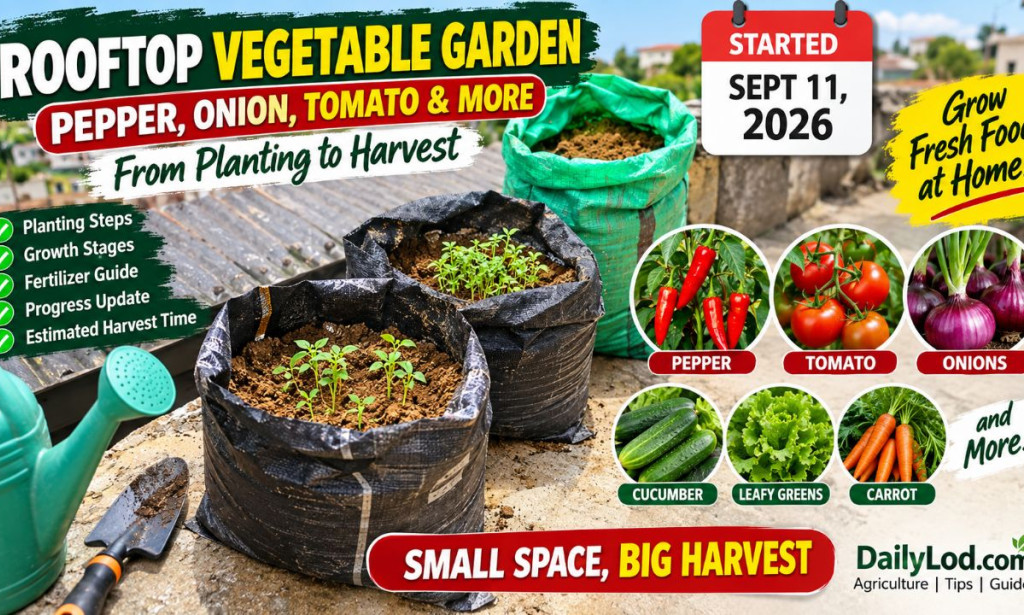
My Rooftop Vegetable Garden Journey: Pepper, Onion, Tomato and Other Crops From Planting to Harvest
Category: Agriculture & Farming
Project Start Date: September 11, 2026
Location: Nigeria
Growing vegetables does not always require a large farm. With a few grow bags, suitable soil, fertilizer, regular watering and enough sunlight, it is possible to produce vegetables right from a rooftop, balcony or small compound.
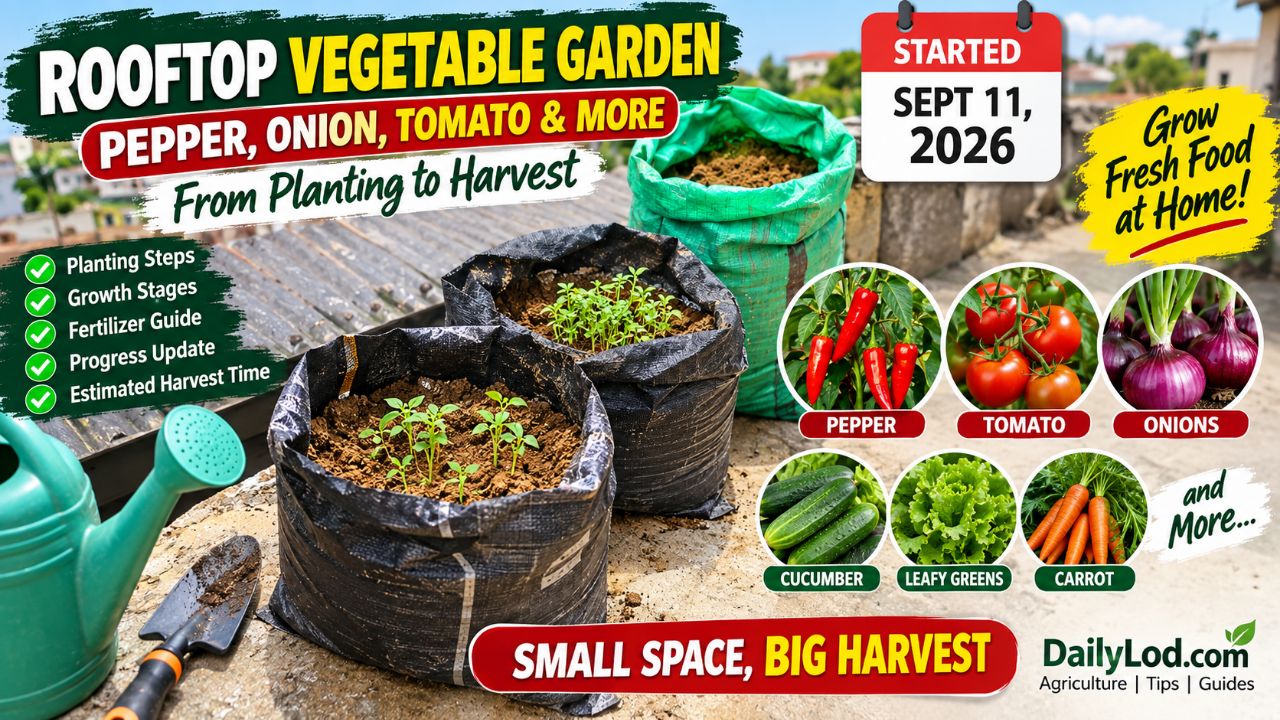
Introduction
On September 11, 2026, I started a small rooftop vegetable-growing project. The goal is simple: grow useful food crops in bags and document the entire process from preparing the soil and planting the seeds to germination, transplanting, flowering, fruiting and finally harvesting.
The main crops I planned to grow are hot pepper, onions and tomatoes. I also considered adding other vegetables that can perform well in containers, including cucumber, beans, radish, carrots, leafy vegetables and garden egg.
This article will serve as a progress diary for the project. Instead of only showing the final harvest, the aim is to document what happens at every stage: how the seeds germinate, how the seedlings develop, when fertilizer is applied, how often the plants are watered, when flowers appear, when fruits begin to develop and when the first harvest is made.
Starting the Rooftop Garden
The garden is being established using bags as planting containers. The bags are filled with locally available sandy soil. Because container plants have limited root space, the quality of the growing medium is particularly important.
Container vegetables generally require good drainage, adequate moisture, appropriate sunlight and sufficient nutrients. Extension guidance also recommends selecting a container large enough for the crop and making sure that excess water can drain from the bottom.
The grow bags used in this project are therefore being treated as small individual vegetable beds.
Grow bags prepared for the rooftop vegetable-growing project.
The Soil I Am Using
The soil available for this project is relatively sandy. Sandy material has an advantage because water can drain easily, but it can also lose moisture and nutrients quickly.
For this reason, organic matter such as mature compost can be very useful. Compost helps improve the growing medium and can increase its ability to retain moisture and nutrients.
However, if compost or animal manure is not available, vegetables can still be grown using a suitable fertilizer program. Container-growing guidance recommends following the fertilizer manufacturer's label rather than applying fertilizer excessively.
Important fertilizer rule
Fertilizer should not be placed directly against newly planted seeds. A concentrated fertilizer source can damage germinating seeds and young roots. Once the plants have established themselves, fertilizer can be introduced according to the instructions on the particular fertilizer being used.
Frequent watering can also cause nutrients to leach out of containers, which is why container vegetables often require periodic feeding.
Do not copy a fixed fertilizer spoon measurement from another fertilizer product. Different fertilizers have different concentrations. The safest approach is to check the fertilizer label and use the recommended rate for vegetables and the size of the container.
September 11, 2026: Day 1 — Planting Begins
September 11, 2026 is the official Day 1 of this gardening project. The first stage involves preparing the bags, checking drainage, preparing the growing medium and planting the selected seeds.
The three main crops are:
- 🌶️ Hot pepper
- 🧅 Onion
- 🍅 Tomato
Other crops can be added later so that the garden does not depend on one harvest period.
How Long Will the Crops Take From Seed to Harvest?
One important thing to understand is that there is no single harvest date that applies to every variety. Seed packets, climate, temperature, sunlight, watering, soil quality and whether the crop is started from seed or from a transplant can all change the schedule.
The following calendar is therefore a practical target range rather than a guarantee.
| Crop | Approximate Cycle | Estimated First Harvest From Sept. 11 | Important Note |
|---|---|---|---|
| 🌶️ Hot Pepper | About 90–150+ days from seed | December 10, 2026 – February 8, 2027+ | May continue producing for many weeks. |
| 🧅 Onion | About 90–120+ days depending on variety | December 10, 2026 – January 9, 2027+ | Green onions can be harvested much earlier. |
| 🍅 Tomato | About 90–130+ days from seed | December 10, 2026 – January 19, 2027+ | Dwarf/container varieties can be faster. |
| 🥒 Cucumber | About 50–70 days | October 31 – November 19, 2026 | Needs good sunlight and support. |
| 🫘 Bush Beans | About 45–60 days | October 26 – November 10, 2026 | Fast crop suitable for containers. |
| 🌱 Radish | About 25–40 days | October 6 – October 21, 2026 | One of the quickest crops to harvest. |
| 🥬 Leafy Greens | About 30–50 days | October 11 – October 31, 2026 | Some leaves can be harvested before full maturity. |
| 🥕 Carrot | About 60–80+ days | November 10 – November 30, 2026+ | Needs sufficient soil depth. |
| 🍆 Garden Egg / Eggplant | About 90–120+ days | December 10, 2026 – January 9, 2027+ | Requires a reasonably large container. |
Hot Pepper Growing Cycle
Hot pepper is one of the main crops in this project. Pepper plants can take some time to develop from seed, but once established they can continue producing fruits over an extended period.
Stage 1: Germination
The first stage is seed germination. Depending on seed quality and growing conditions, pepper seeds may take roughly one to two weeks to emerge.
Stage 2: Seedling Development
After germination, the seedlings develop their first true leaves. At this stage, watering should be controlled carefully. The soil should remain reasonably moist but not permanently waterlogged.
Stage 3: Transplanting or Thinning
If several pepper seeds germinate in the same small area, they should eventually be thinned or carefully transplanted so that the strongest plants have enough space.
For the larger bags shown in this project, I would avoid overcrowding the pepper plants.
Stage 4: Vegetative Growth
The plant begins producing more leaves and branches. Good sunlight, consistent moisture and adequate nutrients become increasingly important.
Stage 5: Flowering
Flowers eventually appear. This is an important transition because the plant is moving from primarily producing leaves and stems to producing fruit.
Stage 6: Fruiting
After successful pollination, small peppers begin forming. The fruits can then be harvested when they reach the desired size and maturity.
Pepper guidance emphasizes fertile, well-drained soil and consistent moisture, particularly around flowering and fruit production.
Onion Growing Cycle
Onions are another crop planned for the garden. Onion production can vary considerably depending on the variety and whether the goal is to harvest green onions or mature bulbs.
Green Onion Option
If the onions are grown primarily for their green leaves, they can be harvested significantly earlier than mature bulb onions.
Bulb Onion Option
For mature bulbs, the plants need considerably more time. The onion plant first develops leaves and roots before putting energy into bulb formation.
When the bulbs mature, the leaves eventually begin to bend or fall over. Harvest timing should also be guided by the particular onion variety.
Tomato Growing Cycle
Tomatoes are one of the crops I want to test in the rooftop garden. However, tomatoes require more space than small leafy vegetables.
Container-growing guidance recommends giving tomato plants significantly more root space than many smaller vegetables. Dwarf, patio and other container-friendly tomato varieties are particularly useful where space is limited.
Tomato stages
- Seed germination
- Seedling development
- Transplanting
- Vegetative growth
- Flowering
- Fruit formation
- Fruit enlargement
- Color development
- Harvest
A tomato plant may also need a stake, cage or other support as it grows. Container-growing guidance recommends providing support for plants that require staking or caging.
My September 22, 2026 Progress Update — Day 12
As of September 22, 2026, this project is approximately 12 days old from the September 11 planting date.
The latest photographs show the grow bags positioned on the rooftop. One of the bags clearly has a group of young green seedlings emerging from the soil. This indicates that germination has started in at least one planting area.
Day 12 progress update: young seedlings are visible in one of the rooftop grow bags.
At this stage, the most important tasks are not harvesting yet. The focus should be on protecting the young seedlings, maintaining suitable moisture, providing enough sunlight and preventing overcrowding.
I will continue documenting the project as the plants move from seedlings into stronger plants, flowering and eventually fruit production.
What Should I Do With the Young Seedlings?
Do not rush to remove seedlings immediately after they appear. First allow them to develop and become easier to identify.
If many seedlings have emerged very close together, they may eventually need thinning. Crowded plants compete for water, nutrients, light and root space.
The exact number to retain depends on the crop and the size of the grow bag. Large fruiting plants such as tomatoes generally require much more space than radishes or leafy greens.
How Much Sunlight Does the Rooftop Garden Need?
Sunlight is extremely important for fruiting vegetables such as pepper and tomato. Container-growing guidance generally recommends placing full-sun vegetables where they can receive at least about six hours of direct sunlight.
Because this garden is on a rooftop, sunlight may be abundant. However, excessive heat can also cause the soil in bags to dry rapidly.
Therefore, the plants need a balance: plenty of light while maintaining adequate soil moisture.
Watering the Plants
Watering will be one of the most important parts of this project because grow bags can dry faster than plants growing in the ground.
The goal is not to keep the soil permanently soaked. Most container vegetables prefer soil that is moist rather than continuously waterlogged.
- Check the soil before watering.
- Water thoroughly when the soil is becoming dry.
- Make sure excess water can drain from the bottom.
- Pay particular attention during very hot weather.
- Avoid allowing young seedlings to dry out completely.
Extension guidance notes that container plants may need frequent watering, sometimes even more than once a day during hot, dry conditions, depending on the container and weather.
Fertilizing the Rooftop Vegetables
Since the soil being used is relatively sandy and the project does not currently rely on animal manure, fertilizer will be an important source of plant nutrients.
However, fertilizer should be used carefully. More fertilizer does not automatically mean more vegetables. Excess fertilizer can damage roots and create nutrient problems.
A general-purpose vegetable fertilizer can be used as a starting point, provided the product is suitable for vegetables and the label instructions are followed.
Container-growing guidance recommends regular nutrient replacement because frequent watering can wash nutrients out of the container.
Once plants move toward flowering and fruit production, a fertilizer with relatively more phosphorus or potassium than nitrogen may be useful, depending on the product and the plant's nutrient requirements.
Important: The fertilizer rate should always come from the specific fertilizer label. Do not assume that one tablespoon or one handful is suitable for every NPK fertilizer.
Other Crops I Can Add to the Garden
One advantage of container gardening is that different crops can be planted at different times. This makes it possible to create a continuous harvest rather than waiting several months for only pepper and tomatoes.
Fast crops
- Radish
- Leafy greens
- Mustard greens
- Some varieties of lettuce
- Green onions
Medium-cycle crops
- Bush beans
- Cucumber
- Carrots
- Beets
Longer-cycle crops
- Hot pepper
- Tomatoes
- Garden egg / eggplant
Extension resources list peppers, carrots, potatoes, tomatoes, radishes, leafy vegetables and several herbs among crops that can be grown in containers, while smaller or dwarf varieties can make container gardening easier.
Estimated Rooftop Harvest Calendar
| Date | Approx. Project Day | Expected Activity |
|---|---|---|
| September 11, 2026 | Day 1 | Soil preparation and planting |
| September 18–25 | Days 8–15 | Early germination may occur depending on crop and conditions |
| September 22, 2026 | Day 12 | Young seedlings visible in at least one bag |
| Late September – October | Days 15–50 | Seedling growth, thinning and early plant development |
| October 2026 | Days 20–50+ | Possible harvest period for some fast-growing greens and radishes |
| Late October – November | Days 45–70+ | Possible beans and cucumber harvests |
| November – December | Days 75–110+ | Continued growth; some early crops may be ready |
| December 2026 – January 2027 | Days 90–130+ | Possible first pepper, tomato, onion or garden-egg harvests |
| January – February 2027+ | Days 120–150+ | Later harvests for crops requiring more time |
These dates are estimates. The actual harvest date will be recorded as the plants develop rather than assuming that every crop will mature on the same day.
Why I Am Documenting the Entire Process
Many agriculture articles show only the final harvest. This project is different because I want to document the entire journey.
The progress will include the good results as well as problems. If a plant fails to germinate, develops yellow leaves, suffers from pests, becomes stunted, receives too much water or produces a poor harvest, that will also be part of the record.
This makes the project useful as a practical learning experiment for people who want to grow food at home without owning a large farm.
What I Will Monitor During the Project
- 🌱 Germination rate
- 🌿 Seedling growth
- ☀️ Sunlight exposure
- 💧 Watering frequency
- 🌾 Fertilizer applications
- 🐛 Pest problems
- 🌼 Flowering dates
- 🍅 First fruit formation
- 🌶️ First pepper harvest
- 🧅 Onion bulb development
- 🍅 Tomato ripening
- ⚖️ Total harvest
Potential Problems to Watch For
1. Overwatering
Constantly wet soil can cause root problems. The bags must have drainage holes.
2. Soil drying too quickly
Sandy soil and rooftop heat can cause rapid moisture loss. Check the soil regularly.
3. Too much fertilizer
Excess fertilizer can damage roots. Always follow the product label.
4. Overcrowding
Too many plants in one bag compete for limited water, nutrients and root space.
5. Strong wind
Rooftops can be windy. Tall tomato and pepper plants may eventually need stakes or other support.
6. Pests
Inspect the leaves regularly for insects, holes, curling leaves, discoloration and other signs of damage.
Container Size Matters
One of the biggest lessons from this project is that different crops do not have identical space requirements.
A small bag may be suitable for onions, radishes or leafy vegetables, but larger fruiting plants such as tomatoes need substantially more root space.
For tomatoes, choosing a dwarf or patio variety can make rooftop container growing easier. Peppers are also well suited to containers when sufficient root space is provided.
My Main Goal for This Project
The main goal is not simply to grow a few vegetables. The goal is to learn whether a small rooftop garden using grow bags can produce useful food with relatively simple materials.
If the first planting succeeds, the next step will be to increase the number of bags and introduce additional crops. I can also begin planting new crops at intervals so that harvesting is spread across different weeks instead of having everything mature at once.
Final Thoughts
The rooftop garden officially started on September 11, 2026. By September 22, the project had reached approximately Day 12, and young seedlings were already visible in one of the bags.
The next major milestone will be watching the seedlings develop their true leaves and become strong enough to establish properly. After that, the project will move into the vegetative-growth stage, followed by flowering, fruit development and harvesting.
Pepper, onions and tomatoes will take longer than quick crops such as radishes and leafy vegetables, so adding some fast-growing vegetables can provide earlier results while the longer-cycle crops continue developing.
This is now an ongoing agriculture experiment, and the next updates will record the actual progress rather than relying only on estimated dates.
From a few bags of soil on a rooftop to the first harvest — this is the beginning of the journey. 🌱🌶️🧅🍅
Project Progress Log
| Date | Project Stage | Progress |
|---|---|---|
| September 11, 2026 | Day 1 | Grow bags prepared and planting project started. |
| September 22, 2026 | Day 12 | Young seedlings visible in one of the bags. |
| Next update | Coming soon | Seedling growth, identification and thinning will be documented. |
Frequently Asked Questions
How long does pepper take to harvest?
Hot pepper can take roughly three to five months or longer from seed, depending on variety and growing conditions. Some peppers may begin producing earlier, while others take longer.
How long does tomato take from seed to harvest?
A practical estimate is roughly three to four months or longer from seed, although dwarf and early varieties can differ significantly.
How long does onion take to mature?
Mature bulb onions commonly require several months. Green onions can be harvested much earlier.
Can vegetables really grow in bags?
Yes. Many vegetables can be grown successfully in containers and grow bags when the container is appropriately sized, has drainage and receives the necessary water, light and nutrients.
Can I use fertilizer without manure?
Yes. Fertilizer can provide essential nutrients even when manure or compost is unavailable. Follow the fertilizer label carefully and avoid overfeeding.
Can I grow vegetables on a rooftop?
Yes, provided the location is safe, the containers are stable, drainage is properly managed, and the roof can safely support the additional weight of wet soil and containers.

You must be logged in to post a comment.