
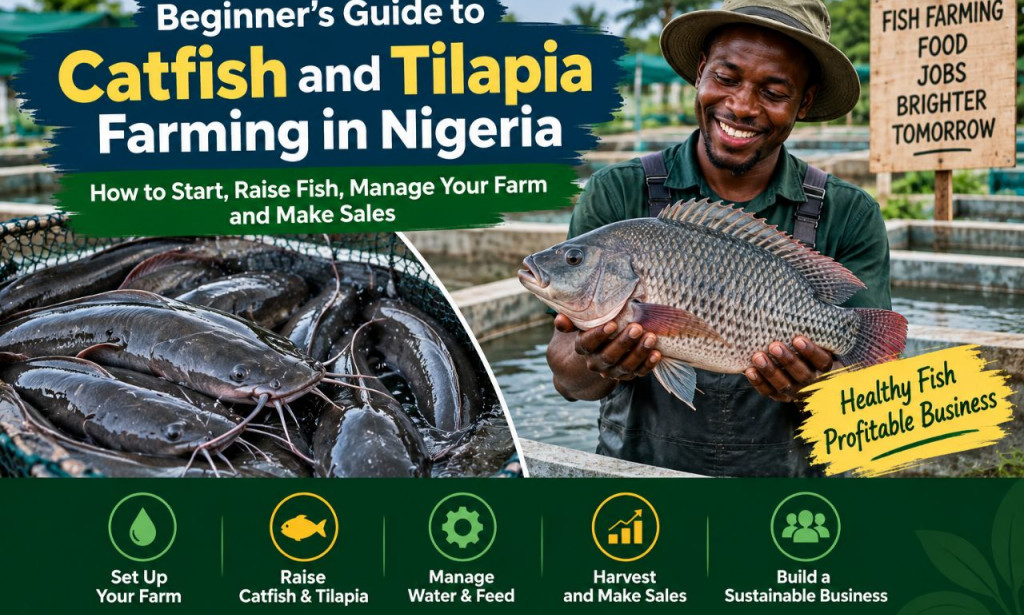
Beginner's Guide to Catfish and Tilapia Farming in Nigeria: How to Start Fish Farming Successfully
Catfish and tilapia farming are two aquaculture businesses that beginners in Nigeria may consider when looking for an agricultural enterprise involving fish production.
Fish farming can look simple from the outside: prepare a pond or tank, buy fingerlings, feed the fish and wait until they grow. In reality, successful fish farming requires proper planning, reliable water, suitable stocking, quality feed, good fish stock, regular monitoring, record keeping and a clear market.
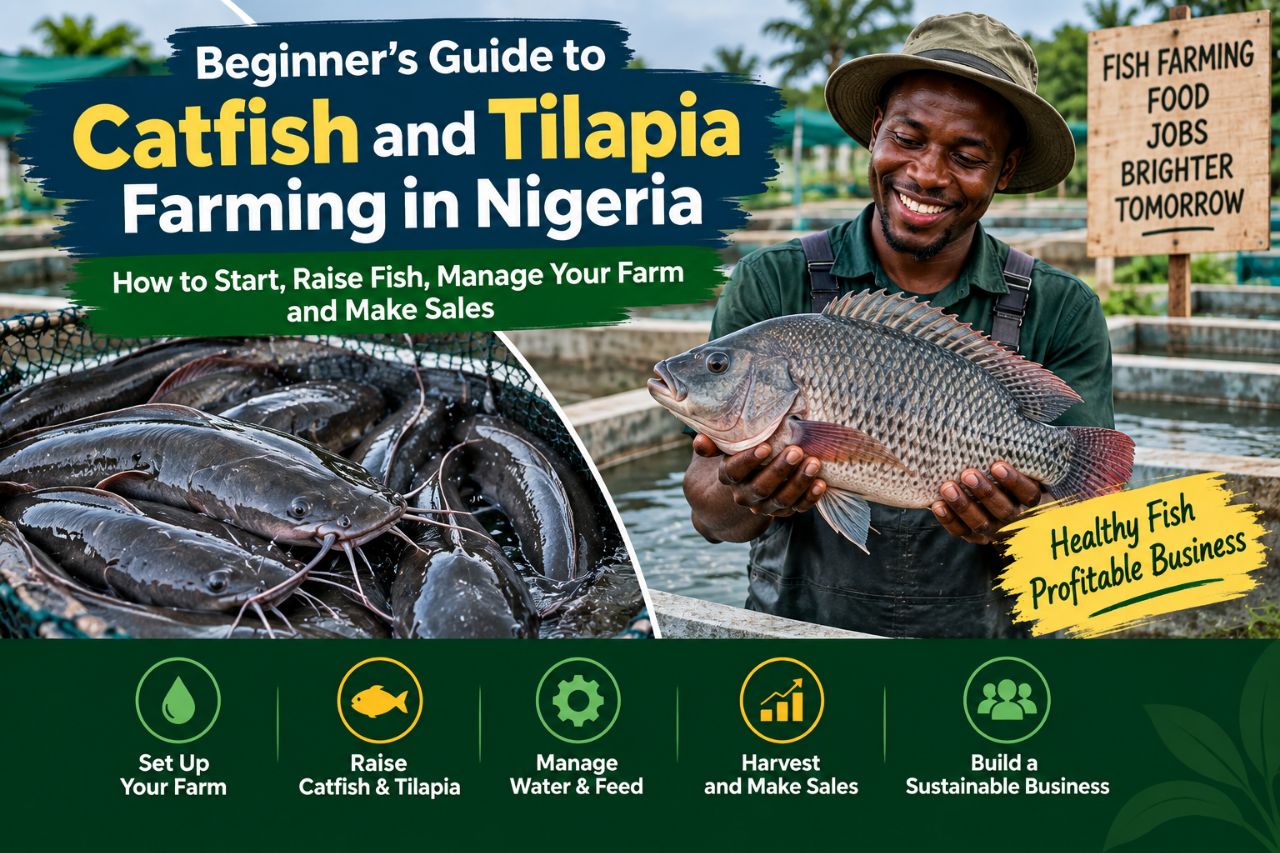
This beginner's guide explains the fundamentals of catfish and tilapia farming, including how to choose between them, prepare a farm, select fingerlings, manage water, feed fish, control stocking, monitor growth, prepare for harvest, find customers and calculate whether the business is actually profitable.
Table of Contents
- What Is Fish Farming?
- Why Consider Catfish and Tilapia Farming?
- What Is Catfish Farming?
- What Is Tilapia Farming?
- Catfish vs Tilapia
- How to Choose Between Catfish and Tilapia
- Find Your Fish Market Before Stocking
- How Much Money Do You Need?
- Choosing a Fish Farm Location
- Types of Fish Farming Systems
- Preparing a Fish Pond
- Tank Fish Farming
- Water Management
- Choosing Fingerlings
- Fish Stocking
- Fish Feeding
- Monitoring Fish Growth
- Fish Health and Biosecurity
- Fish Farm Record Keeping
- Harvesting Catfish and Tilapia
- How to Sell Your Fish
- How to Calculate Fish Farming Profit
- Common Beginner Mistakes
- How to Scale Your Fish Farm
- Beginner Fish Farming Checklist
- Frequently Asked Questions
- Conclusion
What Is Fish Farming?
Fish farming, also called aquaculture, is the controlled production of fish for food, breeding stock, fingerlings or other markets.
Instead of relying entirely on naturally occurring fish populations, a fish farmer controls important parts of the production process.
These can include:
- Fish stocking
- Water management
- Feeding
- Growth monitoring
- Health management
- Predator control
- Harvesting
- Marketing
- Financial management
Catfish and tilapia are two examples of fish enterprises that can be operated using controlled aquaculture systems.
The AMICA animal-farming material emphasizes that a farmer should understand what is being sold, where the fish will be kept, what they will eat, how production works, when they can be sold, who will buy them and what could go wrong before investing. 3
Why Consider Catfish and Tilapia Farming?
Fish farming can be attractive because fish production can be organized in ponds, tanks and other controlled systems depending on the species and farming method.
However, fish farming should not be viewed as guaranteed quick money.
The main business equation is simple:
Every stage affects the final result.
For example, buying cheap fingerlings may not help if survival is poor. Having a large pond may not help if water quality is poor. Producing many fish may not help if there are no buyers when the fish reach market size.
The AMICA fast-turnover guide specifically describes fish production as an enterprise where water quality, feed, stocking density, mortality and sale timing can strongly affect results. 4
What Is Catfish Farming?
Catfish farming involves raising catfish under controlled conditions for sale as table fish, breeding stock or other aquaculture purposes.
The AMICA animal-farming guide classifies catfish as a fast-to-medium aquaculture enterprise.
It describes the basic setup as ponds or tanks with reliable water, drainage, predator control and a stocking plan. It also identifies quality catfish feed, water quality and oxygen monitoring as important inputs. 5
Catfish Production Stages
A simple catfish production model can be divided into:
- Farm preparation
- Fingerling purchase
- Stocking
- Nursery management where applicable
- Grow-out
- Feeding and water management
- Growth monitoring
- Harvest preparation
- Marketing
- Harvest and sales
- Post-cycle financial review
The uploaded material identifies buying fingerlings and using nursery/grow-out systems as the basic production approach, while noting that hatchery breeding is more technical. 6
What Is Tilapia Farming?
Tilapia farming involves raising tilapia in ponds, tanks, cages or other suitable aquaculture systems.
The AMICA guide classifies tilapia as a fast-to-medium enterprise and identifies reliable water and a defined market as important factors.
Tilapia can be produced for table fish, fingerlings or breeding stock depending on the farm model. 7
One Important Tilapia Issue: Reproduction
Tilapia reproduction needs to be properly managed.
If reproduction is not controlled within the production system, excessive numbers of small fish can develop and compete for available resources.
The AMICA guide specifically identifies overpopulation as one of the risks associated with tilapia farming. 8
For beginners, this is an important reason to understand the particular tilapia production system being used before stocking fish.
Catfish vs Tilapia: What Is the Difference?
| Factor | Catfish | Tilapia |
|---|---|---|
| Main product | Table fish | Table fish, fingerlings or breeding stock |
| Planning group | Fast to medium | Fast to medium |
| Indicative production period | About 4–6 months to common table size | About 4–7 months |
| Main management issue | Water quality, oxygen, feed and stocking density | Water quality, oxygen and reproduction control |
| Possible buyers | Households, restaurants, traders and processors | Table-fish buyers, farmers and fingerling buyers |
| Major risk | Poor water quality, low oxygen, overstocking and poor fingerlings | Overpopulation, low oxygen, predators and poor water quality |
The production periods above are indicative planning periods, not guarantees. The AMICA materials explicitly state that timing varies according to breed or strain, starting age, management, environment, target sale size and production system. 9
How to Choose Between Catfish and Tilapia
Do not choose your fish species simply because someone tells you that it is profitable.
Instead, compare the business against your own situation.
Consider Your Capital
How much money can you invest without putting essential personal or business funds at risk?
Consider Your Water
What is your water source?
Is it reliable throughout the production period?
Consider Your Space
Do you have enough space for the pond or tanks, drainage, feed storage and working areas?
Consider Your Market
Who will buy the fish?
Consider Your Management Ability
Can you check the fish and water regularly?
Consider Your Feed Supply
Can you obtain appropriate feed consistently?
The AMICA introductory course recommends comparing capital, space, time, feed, skills, market, risk and scalability before choosing an animal-farming enterprise. 10
Find Your Fish Market Before Stocking
This is one of the most important lessons for a beginner.
Do not stock fish first and start looking for customers later.
Before you buy fingerlings, investigate your local market.
Potential Fish Buyers
- Households
- Restaurants
- Hotels
- Food vendors
- Fish traders
- Market sellers
- Processors
- Smokers
- Retailers
- Other fish farmers
- Fish wholesalers
- Event caterers
The AMICA fast-turnover guide recommends confirming buyers, prices, feed sources and water arrangements before stocking. 11
Questions to Ask Potential Buyers
- What type of fish do you buy?
- How many kilograms do you normally purchase?
- What fish size do you prefer?
- How frequently do you buy?
- What price range do you normally pay?
- Do you buy live fish?
- Do you buy processed fish?
- Do you collect the fish?
- Do you require delivery?
Write down the answers and use them when designing your production plan.
How Much Money Do You Need to Start Fish Farming?
There is no universal startup amount for catfish or tilapia farming.
Your actual budget depends on:
- Number of fish
- Pond or tank size
- Construction costs
- Water source
- Water storage
- Fingerling prices
- Feed prices
- Labour
- Transportation
- Equipment
- Health management
- Electricity or pumping costs
- Security
- Harvesting costs
- Emergency reserve
A proper budget should therefore be created before purchasing fish.
Basic Fish Farm Budget Structure
| Expense | Estimated Cost |
|---|---|
| Pond/tank construction | ₦____________ |
| Water system | ₦____________ |
| Fingerlings | ₦____________ |
| Feed | ₦____________ |
| Labour | ₦____________ |
| Power/pumping | ₦____________ |
| Transport | ₦____________ |
| Harvesting/marketing | ₦____________ |
| Emergency reserve | ₦____________ |
Choosing a Fish Farm Location
Your location can make fish farming easier or more difficult.
Important Location Questions
- Is reliable water available?
- Can the pond or tanks drain properly?
- Is the area prone to flooding?
- Can feed vehicles reach the farm?
- Can harvested fish be transported easily?
- Is the location secure?
- Is there enough room for future expansion?
- Can wastewater be managed responsibly?
A good fish-farm location should support both production and sales logistics.
Types of Fish Farming Systems
Fish can be produced using different systems.
1. Earthen Ponds
Earthen ponds use excavated or naturally suitable soil areas to create a controlled water body.
They can support fish production, but proper water management, drainage, predator control and pond preparation are important.
2. Concrete Tanks
Concrete tanks provide a more controlled environment and can be useful where space or water management makes tanks practical.
3. Plastic or Other Tank Systems
Some small-scale farmers use suitable tanks or containers for controlled fish production.
The important issue is not simply the material of the tank but whether the system provides appropriate water management, stocking capacity, drainage and fish welfare.
4. Cage Systems
Cage aquaculture can be used in suitable water bodies where permitted and properly managed. It requires specialized planning and should not be treated as a simple beginner setup.
The AMICA guide identifies ponds, tanks and, for tilapia, cages where permitted as possible aquaculture systems. 12
Preparing a Fish Pond
A pond should be prepared before fish arrive.
Basic Pond Preparation Checklist
- Inspect the pond structure.
- Check drainage.
- Check water supply.
- Remove unwanted materials.
- Check for leaks where relevant.
- Install or inspect inlet and outlet systems.
- Protect the pond against predators.
- Prepare the feeding area.
- Ensure harvested fish can be removed efficiently.
Do not wait until fingerlings have arrived before discovering that your pond has a drainage or water-supply problem.
Tank Fish Farming
Tank farming can allow greater control over the production environment, but it does not eliminate the need for proper management.
Important Tank Requirements
- Reliable water source
- Suitable tank volume
- Good drainage
- Water replacement arrangements
- Oxygen management
- Feed management
- Protection from predators
- Regular inspection
One advantage of a controlled tank system is that the farmer can monitor the environment more directly. However, a water or oxygen failure can become serious quickly.
Water Management: One of the Most Important Parts of Fish Farming
Fish live in their water. This makes water management fundamentally different from many land-based livestock businesses.
Poor water conditions can affect feeding, growth, stress and survival.
Water Management Checklist
- Monitor water condition regularly.
- Maintain appropriate oxygen availability.
- Prevent excessive organic waste.
- Avoid unnecessary overfeeding.
- Monitor stocking density.
- Maintain suitable drainage.
- Prevent harmful contamination.
- Have a plan for water emergencies.
The AMICA catfish material specifically identifies water quality and oxygen as key management considerations, while tilapia farming also requires water-quality control. 13
Why Oxygen Matters in Fish Farming
Fish require oxygen in the water.
If oxygen availability becomes inadequate, fish may become stressed, reduce feeding or suffer mortality.
Problems can become worse when farmers:
- Overstock the pond
- Overfeed fish
- Allow excessive organic waste
- Have poor water movement
- Experience equipment or power failures
This is why a beginner should understand the water system before deciding how many fish to stock.
Choosing Good Fingerlings
The quality of your starting stock matters.
The AMICA catfish guide identifies poor fingerlings as a major risk. 14
When Buying Fingerlings, Consider:
- Reliable supplier
- Correct species
- Appropriate size
- Active swimming
- General condition
- Uniformity where appropriate
- Transport conditions
- Supplier reputation
Ask the supplier about the source of the fingerlings and their production history where such information is available.
Do not select fingerlings solely because they are the cheapest option.
Fish Stocking
Stocking means introducing fish into the production system.
This is one of the most important decisions in fish farming because stocking too many fish can place pressure on water quality, oxygen, feed and overall management.
Before Stocking, Confirm:
- Pond or tank is ready.
- Water source is reliable.
- Drainage is functional.
- Feed has been purchased or arranged.
- Emergency water arrangements exist.
- Market has been researched.
- Records are ready.
- Fingerlings are sourced from a reliable supplier.
Do not choose stocking numbers simply because another farmer uses that number.
Your appropriate stocking level depends on your production system, fish size, water management, aeration, feeding system and management capacity.
Fish Feeding Guide for Beginners
Feed is one of the largest operating considerations in fish farming.
Good feeding management involves giving fish appropriate feed while avoiding unnecessary waste.
Basic Feeding Principles
- Use feed appropriate for the fish species and size.
- Buy from a reliable source.
- Store feed in a dry location.
- Prevent contamination.
- Observe fish feeding behaviour.
- Avoid excessive feeding.
- Record feed purchases.
- Monitor feed consumption.
Catfish should receive feed appropriate to their size, while tilapia can use suitable commercial feed alongside natural pond productivity where the farming system supports it. 15
Why Overfeeding Is a Problem
Giving more feed than the fish can consume does not necessarily make fish grow faster.
Uneaten feed can contribute to waste and water-quality problems.
Therefore, feeding should be managed according to the fish, water system, production stage and appropriate technical guidance.
Monitoring Fish Growth
Do not simply look at the pond and assume the fish are growing well.
Regular monitoring helps you understand the production process.
Things to Monitor
- Fish survival
- Fish growth
- Feed consumption
- Water condition
- Unusual behaviour
- Mortality
- Stocking numbers
- Estimated harvest quantity
Sampling Fish
Where appropriate, farmers can periodically sample fish to estimate growth and determine whether feeding and production are progressing as planned.
Sampling procedures should be performed carefully to avoid unnecessary stress or injury.
Fish Health and Biosecurity
Fish farming also requires health management.
Common risks include:
- Poor water quality
- Low oxygen
- Overstocking
- Poor-quality fingerlings
- Predators
- Contaminated equipment
- Sudden environmental changes
- Improper feeding
The AMICA material specifically identifies poor water quality, low oxygen, overstocking, predators and poor fingerlings among important catfish or tilapia risks. 16
What to Do When Fish Behave Abnormally
If fish suddenly stop feeding, show unusual swimming behaviour, gather near the surface, show unusual mortality or otherwise appear unhealthy, investigate the water and production conditions immediately and seek appropriate professional aquaculture or veterinary assistance.
Do not randomly apply medicines or chemicals based solely on another farmer's recommendation.
Fish Farm Record Keeping
Records turn fish farming from guesswork into a measurable business.
At minimum, record:
- Date fish were purchased
- Number of fingerlings stocked
- Fingerling cost
- Feed purchases
- Feed quantity
- Feed cost
- Mortality
- Water expenses
- Power/pumping expenses
- Labour
- Transport
- Harvest quantity
- Average fish size
- Sales
- Customer information
The AMICA farming materials recommend recording stock, feed, mortality, growth or production, sales and expenses for each enterprise. 17
Simple Fish Farm Record Template
| Date | Activity | Quantity | Cost | Notes |
|---|---|---|---|---|
| ________ | Fingerlings | ________ | ₦______ | ________ |
| ________ | Feed | ________ | ₦______ | ________ |
| ________ | Mortality | ________ | — | ________ |
| ________ | Water/Power | ________ | ₦______ | ________ |
| ________ | Sales | ________ | ₦______ | ________ |
Harvesting Catfish and Tilapia
Harvesting should be planned rather than treated as an emergency event.
Before Harvesting
- Contact potential buyers.
- Confirm expected quantity.
- Confirm preferred fish size.
- Agree on price where appropriate.
- Arrange transport.
- Prepare harvesting equipment.
- Record the quantity harvested.
- Record fish sold and unsold.
The AMICA production playbook recommends contacting buyers before sale and confirming quantity, size or weight, price and collection or delivery arrangements. 18
How to Sell Your Fish
Fish can be sold through several channels.
Possible Buyers
- Local households
- Restaurants
- Hotels
- Food vendors
- Fish traders
- Processors
- Smokers
- Retailers
- Wholesalers
- Other farmers
Direct Sales
Selling directly to consumers may allow the farmer to communicate directly with customers and develop repeat buyers.
Wholesale Sales
Wholesale buyers may purchase larger quantities, but the selling price and negotiation structure may differ from retail sales.
Restaurant and Food Business Sales
Restaurants and food vendors can potentially become repeat customers if you can consistently supply the size, quantity and timing they require.
Example Fish Sales Advertisement
FRESH FARM FISH AVAILABLE
Fish: Catfish / Tilapia
Quantity: [Insert quantity]
Average size: [Insert actual size]
Price: ₦[Insert current price]
Location: [Insert location]
Collection: [Insert details]
Delivery: [Insert details]
Order: [Insert phone/WhatsApp]
How to Calculate Fish Farming Profit
Never calculate profit by looking only at the amount received from customers.
The basic formula is:
Costs to Include
- Fingerlings
- Feed
- Pond/tank preparation
- Water
- Electricity or pumping
- Labour
- Transport
- Health-related costs
- Harvesting
- Marketing
- Equipment and maintenance
- Mortality and production losses
The AMICA finance material recommends measuring survival rate, feed cost per saleable unit, average sale price, cost per saleable unit and net margin. 19
Simple Example
Imagine a fish farmer has total sales of:
₦600,000
After calculating all relevant costs, suppose the total cost is:
₦480,000
The simplified difference is:
₦600,000 − ₦480,000 = ₦120,000
The ₦600,000 is revenue. The ₦120,000 is the simplified surplus before considering any additional applicable accounting items.
This is why farmers should never confuse sales revenue with profit.
Important Fish Farming Performance Numbers
1. Survival Rate
A simple survival-rate calculation is:
2. Cost Per Saleable Fish
3. Average Sale Price
These measures can help a farmer understand whether the farm is improving from one production cycle to another. 20
Common Beginner Fish Farming Mistakes
1. Stocking Before Preparing the Farm
Do not purchase fish before the pond, tanks, water and drainage systems are ready.
2. Overstocking
Putting too many fish into a system can increase pressure on water quality, oxygen and feed management.
3. Ignoring Water Quality
Fish depend on their aquatic environment. Poor water conditions can affect production and survival.
4. Buying Poor Fingerlings
Starting with poor-quality fish can make the entire production cycle more difficult.
5. Underestimating Feed Costs
Feed can represent a major portion of production expenses.
6. Overfeeding
Excess feed can create waste and contribute to water-quality problems.
7. Having No Emergency Water Plan
A water interruption can become a major problem, especially in intensive systems.
8. Finding Buyers Too Late
Do not wait until harvest week to begin looking for customers.
9. Poor Record Keeping
Without records, you may not know whether the farm actually made money.
10. Starting Too Large
A beginner should learn the production system before committing a large amount of capital.
The AMICA introductory farming material identifies buying before finding buyers, using revenue as profit, starting too large, ignoring records, under-budgeting feed, poor hygiene and choosing by hype as common beginner mistakes. 21
How to Scale Your Fish Farm
Once you complete your first production cycle, do not automatically double the number of fish.
First review your records.
Ask Yourself:
- What percentage of fish survived?
- How much feed was used?
- What was the total feed cost?
- What caused any mortality?
- What was the average sale size?
- How much did customers actually pay?
- What was the total cost?
- What was the actual surplus?
- Did I have enough water?
- Can my current market absorb more fish?
If the system is manageable and the market can absorb additional production, expansion can then be considered.
The AMICA production framework recommends reinvesting and increasing stock only after records show that the system is manageable and buyers can absorb more output. 22
Catfish Farming Beginner Workflow
Here is a simple catfish roadmap:
- Research your local catfish market.
- Identify potential buyers.
- Check current feed and fingerling prices.
- Choose your production system.
- Prepare pond or tanks.
- Secure reliable water.
- Prepare drainage.
- Buy quality fingerlings.
- Stock a manageable quantity.
- Establish feeding routines.
- Monitor water quality and oxygen.
- Record mortality and feed.
- Monitor growth.
- Contact buyers before harvest.
- Harvest according to your production and market plan.
- Record sales.
- Calculate actual production cost.
- Improve the next cycle.
Tilapia Farming Beginner Workflow
- Research local tilapia demand.
- Identify buyers.
- Choose a suitable production system.
- Prepare pond, tanks or other approved system.
- Secure reliable water.
- Choose quality fingerlings.
- Plan reproduction management.
- Stock appropriately for the system.
- Feed according to fish size and production conditions.
- Monitor water quality.
- Monitor oxygen availability.
- Watch for overpopulation.
- Record growth and mortality.
- Contact buyers before harvest.
- Harvest and sell.
- Calculate actual costs and results.
- Improve before expanding.
Beginner Fish Farming Checklist
- ☐ Decide between catfish, tilapia or another suitable fish enterprise.
- ☐ Research local demand.
- ☐ Identify at least two or three potential buyers.
- ☐ Check current fish prices.
- ☐ Check current feed prices.
- ☐ Check current fingerling prices.
- ☐ Choose your production system.
- ☐ Prepare pond or tanks.
- ☐ Confirm reliable water.
- ☐ Prepare drainage.
- ☐ Prepare emergency water arrangements.
- ☐ Find a reliable fingerling supplier.
- ☐ Prepare appropriate fish feed.
- ☐ Prepare feeding equipment.
- ☐ Prepare harvesting equipment.
- ☐ Create farm records.
- ☐ Develop a health and biosecurity plan.
- ☐ Start with a manageable stocking level.
- ☐ Monitor fish regularly.
- ☐ Contact buyers before harvest.
- ☐ Record every sale.
- ☐ Calculate your actual profit or loss.
- ☐ Improve the next production cycle before scaling.
Simple Fish Farming Business Plan Template
| Farm Name | ____________________________ |
| Location | ____________________________ |
| Fish Species | Catfish / Tilapia |
| Production System | Pond / Tank / Other |
| Number of Fish | ____________________________ |
| Fingerling Cost | ₦__________________________ |
| Estimated Feed Cost | ₦__________________________ |
| Water Cost | ₦__________________________ |
| Labour | ₦__________________________ |
| Expected Harvest Period | ____________________________ |
| Target Buyers | ____________________________ |
| Sales Plan | ____________________________ |
Frequently Asked Questions About Catfish and Tilapia Farming
Is catfish farming profitable?
Catfish farming can generate sales, but profitability is not guaranteed. Feed costs, fingerling quality, water management, mortality, selling price and market access all affect the result.
Is tilapia farming profitable?
Tilapia farming can also generate revenue, but profitability depends on production efficiency and market conditions. Reproduction management is particularly important in some systems.
Which is faster, catfish or tilapia?
The AMICA guide gives an indicative period of about 4–6 months for catfish to reach common table size and about 4–7 months for tilapia. Actual timing varies according to the production system, fish stock, environment, management and target sale size. 23
Can I raise catfish and tilapia together?
Do not assume that combining species is automatically better. Mixed-species systems require appropriate technical planning, compatible species, stocking strategy, feeding and water management. Beginners should understand the production system thoroughly before attempting it.
Can I farm fish in tanks?
Yes, tanks can be used for aquaculture, provided the system is designed and managed appropriately for the species and stocking level.
What is the biggest cost in fish farming?
Feed can be a major operating cost, but the actual cost structure varies from farm to farm. Your budget should include feed, stock, water, labour, transport, infrastructure, health and other relevant expenses.
How many fish should a beginner stock?
There is no single number that works for every farm. Stocking should be based on your production system, water management, oxygen availability, fish size, feed system and ability to monitor the fish.
Should I find buyers before stocking fish?
Yes. Market research should happen before stocking. Knowing who will buy your fish and what size and quantity they want can help you design the production plan.
Do I need records for a small fish farm?
Yes. Even a small farm should record fingerlings, feed, mortality, water expenses, labour and sales. Records become increasingly important as the farm grows.
Catfish and Tilapia Farming: The Beginner's Golden Rule
DO NOT START WITH THE FISH.
Start with the MARKET, WATER, BUDGET and PRODUCTION PLAN.
Then choose the fish that fits your situation.
Conclusion: Start Small, Learn, Measure and Improve
Catfish and tilapia farming can be considered by beginners who have access to suitable water, sufficient working capital, appropriate infrastructure and a clear market.
But the business should be approached as a complete production system rather than simply buying fish and feeding them.
Before stocking your first fish:
- Research your market.
- Understand your water source.
- Prepare your pond or tanks.
- Calculate feed requirements.
- Buy suitable fingerlings from a reliable source.
- Choose a manageable stocking level.
- Monitor water and oxygen conditions.
- Keep records.
- Contact buyers before harvest.
- Calculate your real production cost.
The first goal should not be to build the biggest fish farm possible.
Your first goal should be to complete a controlled production cycle, understand your numbers, make sales and learn what needs to improve.
Once your records show that the system is manageable and your market can absorb additional fish, you can consider increasing production.
This approach follows the broader farming principle: learn → test → measure → improve → scale. 24
Disclaimer: This article is for general educational and agricultural information. Fish farming involves financial, environmental and animal-health risks. Production periods, costs, mortality, feed requirements, selling prices and profitability vary by location, species, production system and management. Always check current local prices and obtain appropriate professional aquaculture or veterinary advice before making significant investments.

You must be logged in to post a comment.